


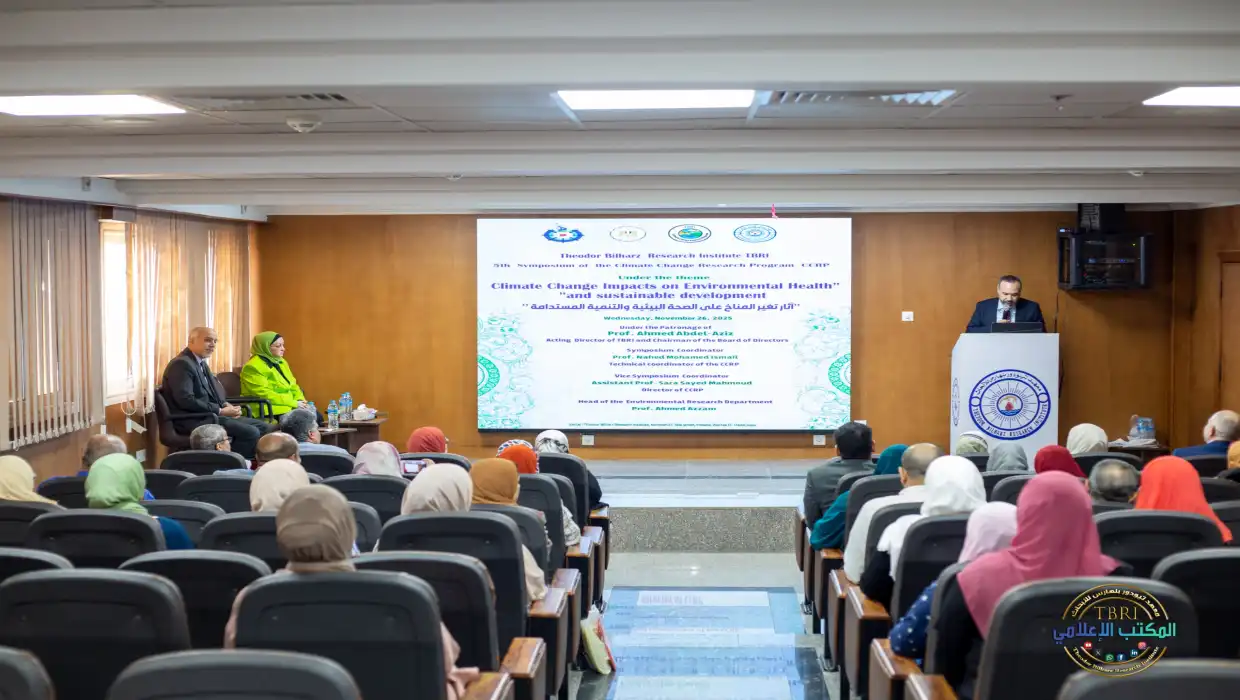
The Climate Change Research Program at Theodor Bilharz Research Institute Holds Its Fifth Annual Symposium Titled “ Climate Change impacts on Environmental Health and Sustainable Development”
As part of the Egyptian government’s focus on climate change and its commitment to contributing effectively to addressing this global challenge, the Climate Change Research Program atTheodor Bilharz Research Institute (TBRI) organized its fifth consecutive annual symposium under the title “Climate Change Impacts on Environmental Health and Sustainable Development.” The event was held under the patronage of Prof. Ahmed Abdel Aziz, Director of the Institute and Chairman of the Board.
The symposium opened with a speech by Prof. Nahed Mohamed Ismail, Technical Supervisor of the Program, who emphasized the importance of organizing such events to review the issue of climate change, present the outcomes of international agreements, and highlight the latest developments in adaptation and mitigation strategies. Prof. Ahmed Azzam, Acting Head of the Environmental Research Department, also delivered remarks on the department’s research plan, which encompasses many components related to protecting aquatic environments and adhering to the Sustainable Development Goals. The plan also includes studying the causes and consequences of climate change on aquatic systems and biodiversity.
In his opening address, Prof. Ahmed Abdel Aziz, Director of the Institute, explained that the Egyptian government has adopted a set of policies and taken numerous measures to confront climate-related challenges and adapt to their impacts. Among these actions was the establishment of the National Council for Climate Change in 2015, chaired by the Prime Minister, as the main national body concerned with climate issues. This was followed in early 2022 by the launch of the National Climate Change Strategy 2050, one of the most significant decisions of the National Council, aimed at enhancing coordination among all ministries and relevant authorities to address climate risks and threats.
He further noted that the strategy includes five main objectives, one of which—Objective Five—focuses on advancing scientific research, promoting technology transfer, and strengthening knowledge management to raise public awareness of the need to confront the risks of climate change. He also highlighted the Institute’s active role in addressing this issue due to the strong connection between climate impacts, environmental quality, and human health. The Institute has implemented several research projects studying the effects of climate change on biodiversity, water quality, and disease emergence. It also launched the Climate Change Research Program, which has organized numerous scientific meetings hosting experts and specialists from various research centers and institutions.
The symposium featured several lectures delivered by distinguished scholars from within and outside the Institute. Prof. Nahed Mohamed Nour El-Din, Head of the Environment and Arid Lands Agriculture Division at the Desert Research Center, gave a lecture on the importance of green cover in mitigating the harmful effects of climate change.
Prof. Salwa Mohamed Dahesh, Professor at the Medical Entomology Research Institute of the General Organization for Teaching Hospitals and Institutes at the Ministry of Health and Population, discussed the impact of climate change on endemic and vector-borne diseases.
Prof. Yasser Hassan Ibrahim, Professor of Air Pollution Chemistry at the National Research Centre, reviewed the different types of air pollutants, their health impacts, and the link between climate change and the increased spread of such pollutants and associated health risks.
Additionally, Prof. Marwa Tamim Ahmed, Professor at the Environmental Research Department at the Institute, presented a lecture on the impact of climate change on fungi and the toxins they produce in various freshwater sources, along with projected scenarios in light of rising temperatures.
Dr. Susan ezzeldin Mahmoud, Researcher at the Environmental Research Department and Certified Sustainable Development Trainer, reviewed the Egyptian government’s efforts to reduce the impacts of climate change across all sectors.
Finally, Dr. Hassan El-Sayed Kilany, Researcher at the Environmental Research Department, addressed the relationship between climate change and water pollution and its implications for the environment.
Prof. Ahmed Abdel Aziz concluded by extending his gratitude to those responsible for organizing the symposium, particularly Prof. Nahed Mohamed Ismail, Technical Supervisor of the Program, and Assistant Researcher Sara Sayed Mahmoud, Administrative Director of the Program, as well as the members of the program and the members of the organizing committee from the Environmental Research and Medical Malacology Division.
Recent News


Meta
- TBRI organizes the fifth symposium of Climate Change Research Program
Tags
- Climate Change Environmental Health Sustainable Development Egypt Climate Strategy 2050 TBRI Symposium Theodor Bilharz Research Institute Climate Change Research Program Climate Change Egypt National Council for Climate Change Climate Adaptation Climate Mitigation Air Pollution Egypt Water Pollution Egypt Biodiversity and Climate Change Green Cover Importance Vector-Borne Diseases Environmental Research Egypt Sustainable Development Goals Egypt Aquatic Environment Protection Climate Change Impacts Environmental Symposium Egypt Climate Research Institutions Egypt Freshwater Fungi Toxins Rising Temperatures Effects Sustainable Development Trainer Egypt Climate Risk Awareness Egypt